Dispute at the Port
By Corey Everitt 07/03/2024
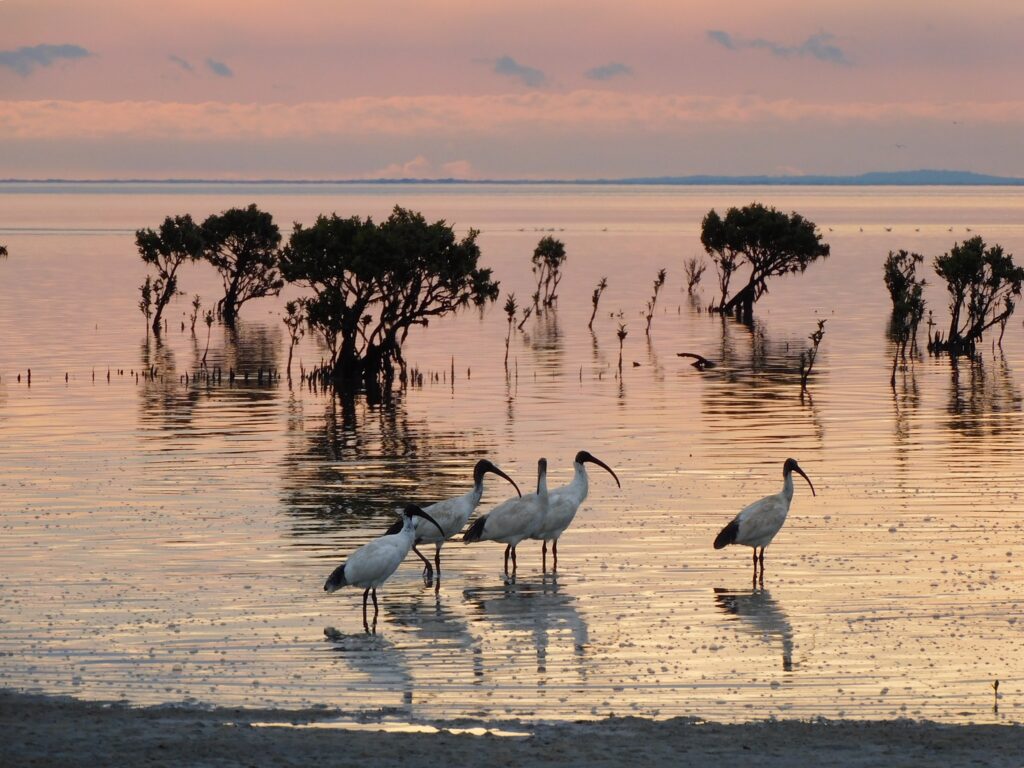
Photo Caption: Ibis at Western Port Bay (Kate Gorringe-Smith)
Western Port became a point of contention between the State and Federal governments this year after a proposal for a wind turbine plant at the Port of Hastings, part of the State’s ambitious plan for an offshore wind industry, was dramatically rejected by Federal Environment Minister Tanya Plibersek on the grounds that it infringed environmental law. Gazette journalist Corey Everitt spoke with Western Port Biosphere CEO Mel Barker about the challenges facing the project and the need for a clear strategy to protect the internationally recognised bay.
The State Government wants Victoria to lead the nation in the renewable energy transition and hopes that, in just over 10 years, 95 per cent of the state’s energy will be sourced from renewables.
As it plans to gradually decommission the remaining coal-fired power plants, the State Government has set its sights on wind energy to play a significant role in the transition.
Under the plan, 1.5 million households would be powered by wind energy by 2032, generated from 2 gigawatts (GW) of production. This would then double to 4 GW by 2035 and increase to 9 GW by 2040.
Victoria is aiming to become the first state in the country to establish an offshore wind industry.
One of the first sites licensed for an offshore wind farm is off the Gippsland coast, with the project titled Star of the South, a partnership between Australian private developers and Danish developer Copenhagen Infrastructure Partners.
The farm would harness the strong winds of Bass Strait to generate a projected 2.2 GW of power, connecting to existing energy infrastructure through Loy Yang and Hazelwood.
The State Government has committed $20 million to the venture, which is considered critical to meeting its energy targets, but the question of where the massive turbine structures would be built remains contentious.
The most suitable locations are ports where turbines can be assembled, requiring large areas of appropriately zoned land with access to existing infrastructure.
The Port of Hastings emerged as the State Government’s preferred construction site, with a large section of crown land available for development and channels deep enough to transport turbines to nearby Gippsland.
Known as the Victorian Renewable Energy Terminal, the project received $27 million in last year’s State budget and was described as getting underway.
Western Port Biosphere, a not-for-profit organisation advocating for the sustainable protection of the bay for the past 20 years, was briefed throughout the process.
“The Port of Hastings was very good with consultation and certainly briefed us when it was chosen as the site,” chief executive Mel Barker said.
“It was only when the referral documentation was released that we really saw the scale of what was proposed.
“At that point, we had concerns about the impact on Western Port and its environment.”
Before those concerns could be formally addressed, the proposal landed on the desk of Federal Environment Minister Tanya Plibersek, where it was vetoed.
“I think a number of stakeholders were surprised,” Ms Barker said.
“It is more common for projects to go through the environmental effects stage, where these concerns are usually addressed, but the Minister made the decision at the application stage.”
The flagship project, intended to mark the beginning of the State Government’s transition to renewables, was rejected on environmental grounds.
In her decision, Minister Plibersek argued the project would cause “irreversible damage” to Western Port’s unique habitat, with parts of the wetlands to be destroyed or substantially modified, impacting a range of native species.
Key points of contention included plans affecting 121 hectares of Western Port, with 29 hectares to be reclaimed and 92 hectares dredged.
Ms Barker outlined how this could have played out.
“There is the reclamation of 29 hectares of wetland, which involves infilling land to form part of the site itself,” she said.
“This is permanent. Any habitat there would have been destroyed, and the Minister noted this in her decision because it is irreversible.
“The dredging would disturb the seabed and sediment would move into other areas, impacting habitats across Western Port and beyond.
“This could affect seagrass, saltmarsh and mangroves.
“From there it could affect native species, such as migratory shorebirds that rely on these habitats to feed.
“All of these factors could have had impacts, some of which would be irreversible.”
While the plan was rejected, the broader project is far from abandoned, with the State Government remaining committed to building turbine infrastructure at a major port.
“Offshore wind is essential for Australia’s energy security and decarbonisation, and we are continuing to push for national leadership to get the industry up and running,” a State Government spokesperson said.
For Western Port Biosphere, the situation presents a difficult balance. The organisation supports renewable energy, but not at the expense of the bay’s vital wetlands.
“It is a tricky balance,” Ms Barker said.
“If this were a fossil fuel project, the position would be clear cut and we would be opposed to it.
“This is about renewable energy and we strongly support an accelerated transition, that is a core principle of Western Port Biosphere.
“However, any major project needs to be designed with an awareness of environmental impact, particularly one in Western Port, which has long-standing international recognition.”
Western Port Bay is a UNESCO-listed biosphere reserve and is also recognised as a Ramsar wetland of international importance, a status raised by Minister Plibersek in her decision.
Despite this international recognition, Western Port continues to be caught up in local and domestic planning issues.
Ms Barker said this was partly due to the absence of a detailed State-level roadmap to guide protection and development, prompting Western Port Biosphere and other organisations to push for a Strategic Framework.
“Given how important Western Port is, it needs an overarching plan that can guide projects like this without disputes escalating between governments,” she said.
“One that allows for renewable energy development while protecting the existing environment.
“At this stage, much of the work has involved engaging with local stakeholders about a potential plan, and we have had an overwhelming response in support from fishing associations, councils, industry and Traditional Owners.
“With this broad support and the Minister’s decision, it only highlights the need for a comprehensive framework.
“Without it, we will continue to see these conflicts until a plan is in place.”
Asked about the proposed strategic framework, the State Government said Western Port is managed under broader planning mechanisms.
“We are working with relevant authorities to protect and manage the environmental values of Western Port Bay, including through the delivery of the Marine and Coastal Strategy 2022, which involves a Marine Spatial Planning Framework to explore where environmental management plans may improve ecological connectivity in bays and inlets,” a spokesperson said.
Western Port Biosphere says it wants a solution that addresses both environmental protection and community needs.
“We are as concerned for people as we are for the environment. They go hand in hand and we always need to find the balance,” Ms Barker said.
“We would be very keen to work with the State Government on an alternative. While we were concerned about the impacts, we remain committed to the project.”