A century old, still ‘tough as nails’
By Corey Everitt 05/10/2024
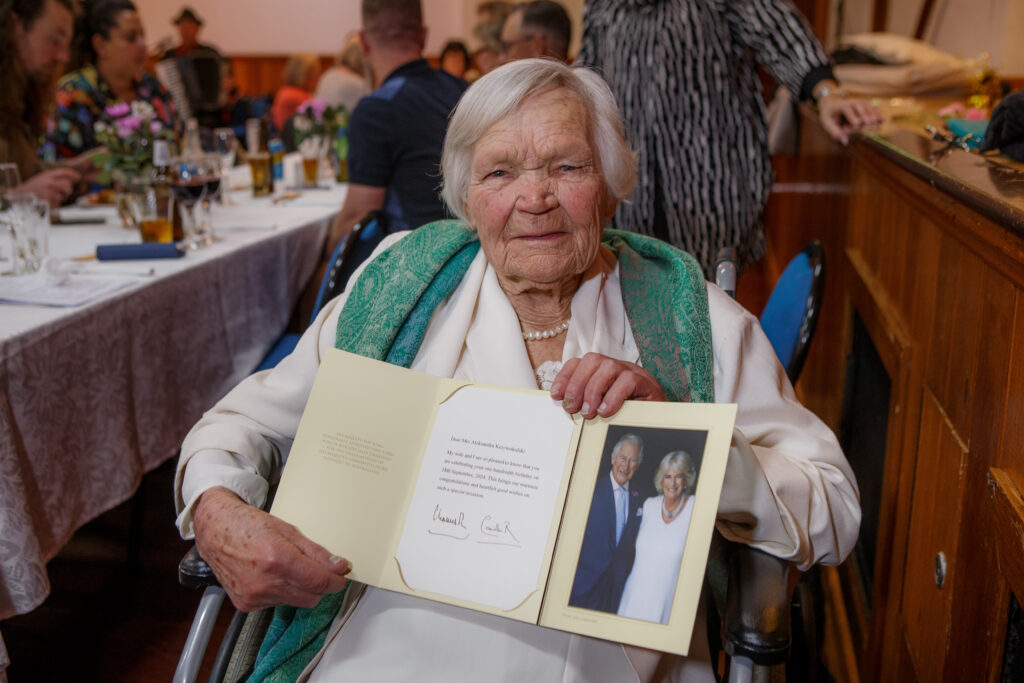
Photo Caption: Alexandra Krzywokulski with her letter from the King. (Gary Sissons)
People today like to talk a lot about generations, about what new rebellious activity Gen Z and the emerging Gen Alpha are up to in the streets or social media to the bewilderment or annoyance of their Gen X or Boomer parents. However, one generation seems to be quickly forgotten over time, the Silent Generation. Now the grandparents and great-grandparents of many, they grew up through some of the darkest days of modern history and persevered to rebuild their lives and families. Alexandra Krzywokulski is one such member and she celebrated her 100th birthday on the weekend. Gazette journalist Corey Everitt spoke with her and her loving children to mark a century of being the ‘backbone’ of the family.
It was a full weekend celebration to mark Alexandra’s 100th year, celebrating on her birthday, Saturday 28 September, at her current residence at Salisbury House in Upper Beaconsfield and then a celebration at the local Polish Community’s House Syrena in Rowville on Sunday.
Over the past few weeks, the letters of congratulations flooded in from King Charles to the Governor-General of Australia, all were read before the gathering on Sunday.
Of the 100 years on the Earth, Alexandra’s wit remains unwavering.
“She wanted to get one from the Queen and she is a bit peeved that the Queen said goodbye to this realm before she has,” her daughter-in-law Krystine Krzywokulski explained.
“She said alright I’ll accept one from the King.”
Born in Ukraine and migrating to Australia after the Second World War, Alexandra has been graced to see her family blossom from her beloved children to many grandchildren and great-grandchildren today.
A blessed lifetime so far, she has also experienced things that should not be seen in any lifetime.
Like many of her generation, she simply got on with it and provided the unassuming, silent ‘pillar of strength’ of her family and community.
“They didn’t have a teenage life, they didn’t have a young adult life, they grew up through hell,” her son John Krzywokulski said.
“They tried to survive and she was a pillar of strength for the whole family.”
Born in Ukraine, Alexandra grew up in a time marked by famine and war.
First living through the Holodomor, where Ukraine was starved by the rule of the Soviet Union. Then being caught in the war as the Eastern Front opened up and swept its devastation across the country.
When the Nazis marched through, she was kidnapped and taken to Germany where she was forced to work as a nanny within the household of a high-ranking officer.
A lowly position of servitude, as the siren rang for approaching Allied bombers she would have to ensure the officer’s family would make it to the shelter before she could rush to seek safety in an entirely separate bunker.
It was during one of these raids that she would find some light of salvation, she was injured by a close explosion and the man who would come to help her recover was Polish man Peter Krzywokulski, who would become her husband.
Surviving the end of the war, their first thought was to get out of Europe.
“It was like everybody at the time, you put down to pretty much go anywhere,” Krystine said.
The place they got was Australia and by 1950 they would be at the old Bonegilla Migration Camp.
“Our fathers used to jump a train and they would come down to Victoria for the whole week to work on the railways,” her son Ted Krzywokulski said.
John added, “it wasn’t easy, they were in Nissen huts, stinking hot in summer, freezing in winter, a lot of people got sick.”
The family was fortunate enough to be taken in by the Waverley Riding School in Melbourne’s South East, the three sisters who owned the property gave them basic needs in exchange for simple labour.
A few years later, they would finally get their home away from home in Noble Park where John and Ted were raised.
Wages were low and the hours were long; Alexandra would walk to the train station in the early hours and would not return home until after the sunsets.
Kystine, who is also the child of Polish migrants, refers to them as effectively ‘latchkey kids’, an unavoidable reality of the time.
Her upbringing and the realities of providing for her children were tough, but it was never something that she would pass on to her children and would not thwart her life.
Alexandra would become the ‘backbone’ to the family and to her community.
Only a few years ago, Alexandra was the guest of honour at House Syrena to mark 40 years of work to the local Polish community.
Alongside her husband, they were founding members of the house where they would both serve as core members from then on.
“It was a community thing they loved to do together because you always have your connection, your heritage to your immediate family, your extended friends because of the language, the bond you had with them,” Krystine said.
“My mum and her were best of friends, she unfortunately passed away 15 years ago, you looked to other people who have experienced what you have experienced.”
Despite their own upbringing, the raising of their family would be seen with only warmth. For her grandchildren, she would be known as ‘Nana Caw Caw’.
“Their father had little bantam chooks in the backyard and would talk to them and he swore that they understood him, he would go ‘caw caw caw’ and he would talk to the other one,” Krystine recounted with a smile.
“Our grandchildren used to see that so they started to call her Nana Caw Caw.”
Even at her 100th birthday, there was still more to appreciate of their mother for John and Ted, in the last few years she was cared for by John where she still had the persistence to tend to the veggie garden and take in the scenery of his Gembrook home.
Ted, who himself saw conflict as a young man in Vietnam, said he has become even closer to his mother as he has understood the battles she has gone through.
“I think I understand Mum a lot more now, of what she went through and I think there is a lot more appreciation for what she battled,” he said.
“All those women of that generation were the backbone, you talk to anyone of our generation and you’ll find the mothers were tough as nails.”
There were many historic wrongs in the 20th century and Alexandra saw several lifetimes worth of it, her long and happy life since, now at a century, stands as her own act of defiance.
“I have seen war and devastation, but I’m still alive and here at 100 years,” she said.