Farmer hit with 400 per cent rate hike
By Corey Everitt 25/09/2024
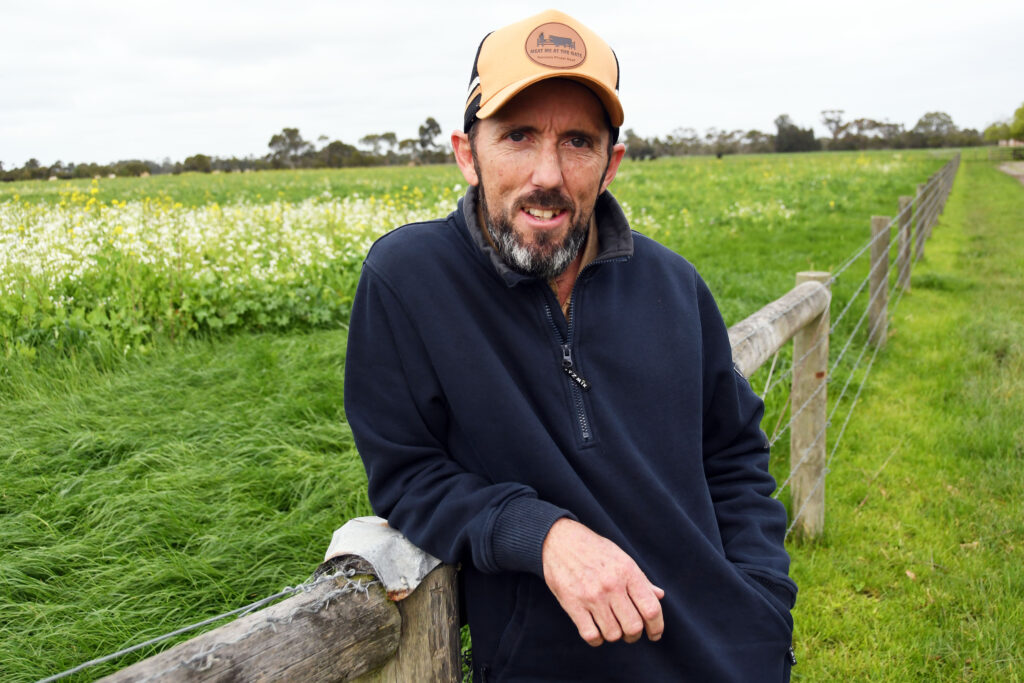
Photo Caption: Simon Beard (Stewart Chambers)
Officer South’s Meat Me at the Gate has seen a 400 per cent hike in its rates in just four years, revealing the dire situation facing local farmers besieged by urban development and prompting calls for greater protection in the clash between city and farm.
Simon and Michelle Beard have been running their much-beloved farm-to-plate beef operation off Cardinia Road for close to five years, a return to the farm that has been in the family for three generations.
However, during that time their rates have skyrocketed by 400 per cent. Almost a quarter of their average annual gross income now goes towards servicing council rates.
Michelle took to the farm’s Facebook page to air frustrations about the shire “rating farmers out”.
“For our family, like others that have been on the same farm for generations, the urban sprawl has big implications,” the post said.
“Our simple way of life, trying to sustain our family, becomes an impossible task.”
Cardinia is fortunate enough to have differential rates for farmers, but for farms at the flashpoint of urban growth this does little to stem the inflation of their property values.
Meat Me at the Gate is within the green wedge, but in the future will be surrounded by factories and suburban housing, as the farm is directly cut out of the Officer South and Cardinia Precinct Structure Plans.
The rate hike has occurred while there are still paddocks around the farm, with land values skyrocketing in anticipation of development in the surrounding area.
“It’s a bigger issue than just us and it’s not only Cardinia Shire that is experiencing this,” Simon said.
“It’s the clash between suburban development and farming land. We have rates like urban growth, but we are farming land.
“In prime farmland through Gippsland, values would be around $20,000 an acre, but that’s not the case here.”
For Simon, farmers in close proximity to urban growth are left vulnerable to land bankers, and it delegitimises the protections afforded by the green wedge.
The way the Precinct Structure Plans have been designed means the farm will eventually be surrounded by factories on three sides.
Additionally, the farm has a flood overlay, which effectively makes it undevelopable.
“Land bankers are inflating land values to lock it up, buy it and not farm,” Simon said.
“It’s a blight on the area. You look at Bald Hill Road, there are farms there that have been ruined by this because they have been bought up.
“I’m not saying you should lock up the urban growth area, but its current state is unworkable.”
The rising land values have been accompanied by deteriorating local amenities. Increasing development along Cardinia Road has made roadworks almost constant, with traffic also increasing.
Simon says it is no longer a country road, yet it is still maintained like one, and getting from the farm to the freeway can be arduous.
Development to the north may also be contributing to increased flooding. The farm has been underwater twice this year, something Simon says would never have happened 15 years ago.
Simon believes there needs to be more consideration given to the interface between farming and urban land, accounting for differing needs and protecting farms from second-hand inflation. At the very least, he says the buffer must be better than the simple carve-out of his farm.
Cardinia Victorian Farmers Federation president Tony Morgan said it is a significant issue and that he has even seen land banking activity near his own farm in Bayles.
“We have the benefit of differential rates and we are considered, but because of our proximity to the urban growth area, values are being inflated beyond what a farmer can earn,” he said.
“Simon and Michelle are doing a top job at that farm, but it is getting harder and harder to sustain.
“Maybe we need to change the differential rate, or we should look at adjusting the way farmland is valued, making it valued as a farm.”
In July, the VFF made a submission to the State Government’s inquiry into local government funding, pointing the blame at the failure of rate capping.
VFF president Emma Germano said the burden is “shifting more and more” to farmers and called for the rate cap to be applied to each land type.
Cardinia Shire Council was contacted for comment.